Hopfield vs MLP
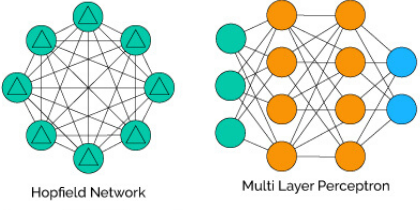
- Hopfield
- Non supervised
- Information retrieval
- Learning and retrieval
- Non supervised
- MLP
- Supervised
- Classification
- Regression
- Training and test
- Supervised


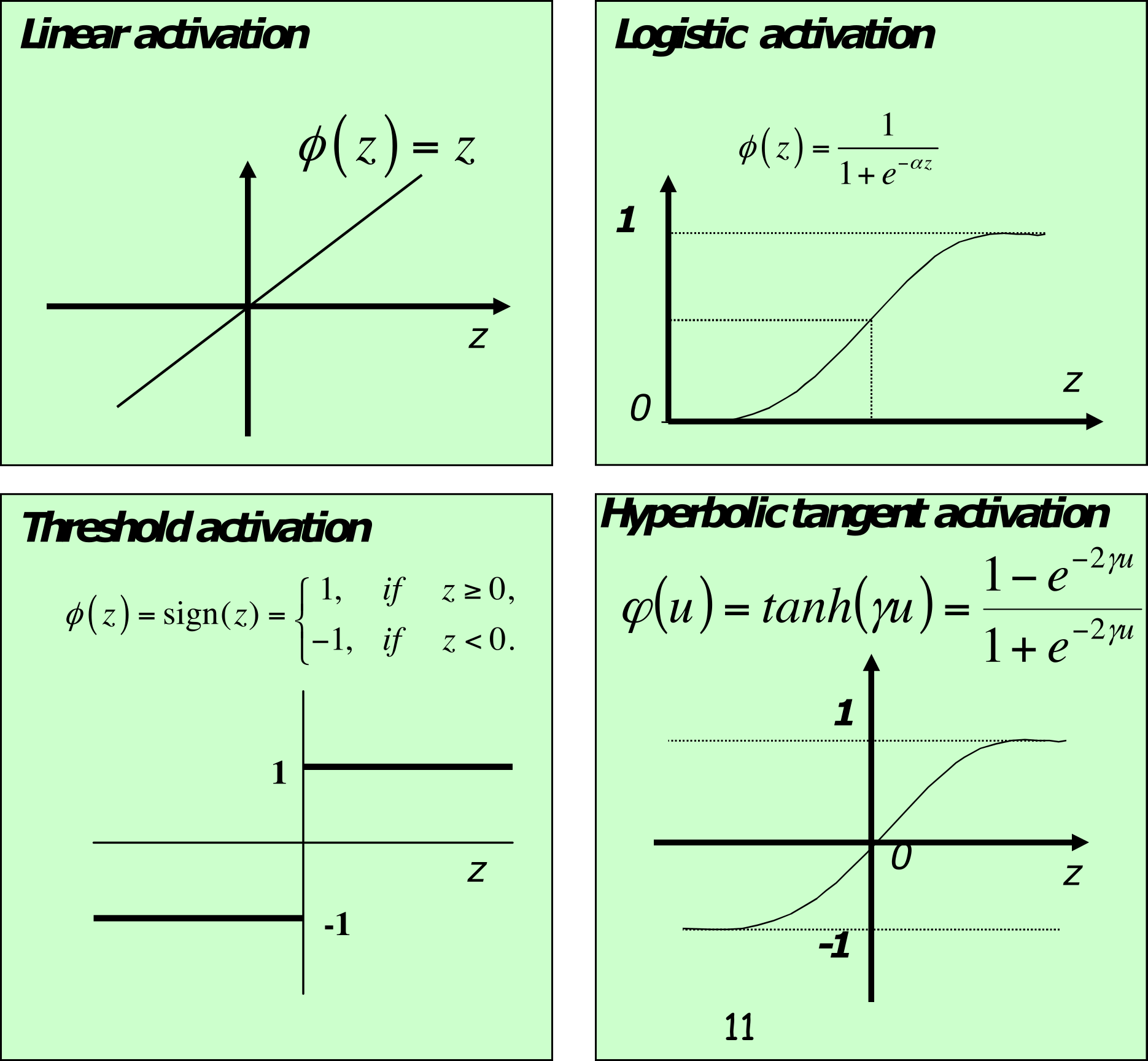
Popular activation functions
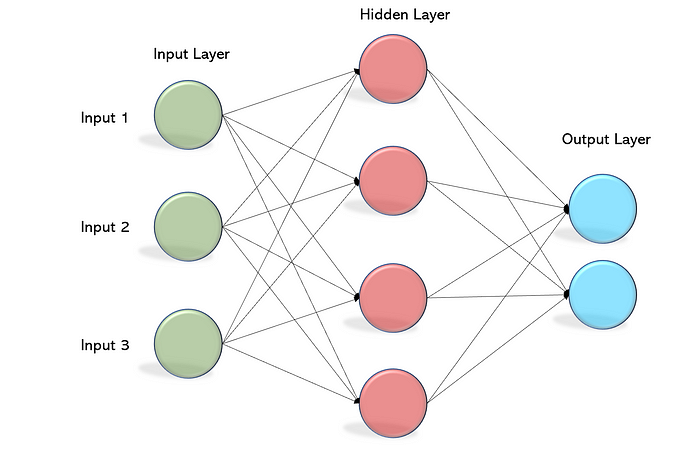
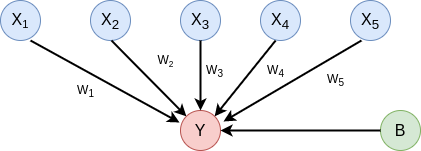
Feed forward the information
- output of first layer
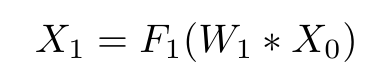
- nth layer output
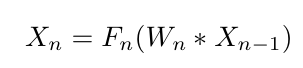
- measure error of the output with the target

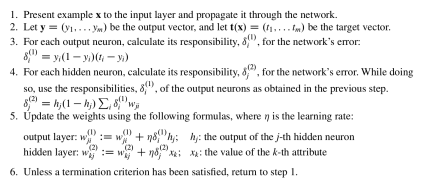
The learning algorithm (backpropagation)
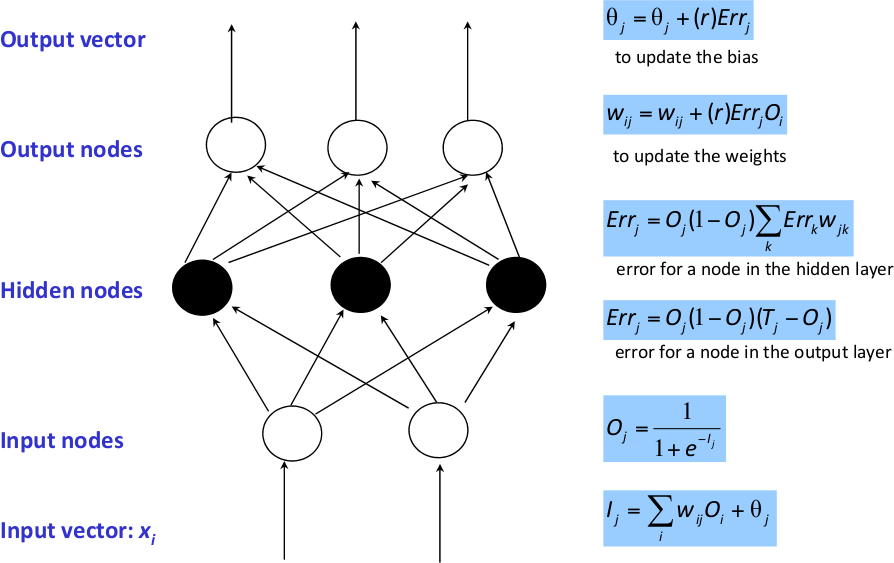
Backpropagation pseudocode

In [5]:
import numpy as np
import matplotlib.pyplot as plt
from sklearn.metrics import mean_squared_error

# Parameters, neurons: input, hidden, output
N_i = 2; N_h = 4; N_o = 1

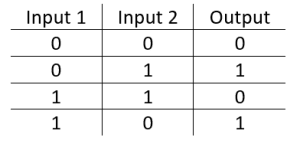
# XOR input
r_i = np.matrix('0 1 0 1; 0 0 1 1')

# XOR output
r_d = np.matrix('0 1 1 0')

r_i.T, r_d.T
Out[5]:
# Initialize randomly the weights
# Hidden layer
w_h = np.random.rand(N_h,N_i) - 0.5
# Output layer
w_o=np.random.rand(N_o,N_h) - 0.5
training_steps = 10000
mse = []

for i in range(training_steps):
    # Select training pattern randomly
    i = np.floor(4*np.random.rand()).astype('int')
    # Feed-forward the input to hidden layer
    r_h = 1 / (1 + np.exp(-w_h*r_i[:,i]))
    # Feed-forward the input to the output layer
    r_o = 1 / (1 + np.exp(-w_o*r_h))
    # Calculate the network error
    d_o = (r_o*(1-r_o)) * (r_d[:,i] - r_o)
    # Calculate the responsability of the hidden network in the error
    d_h = np.multiply(np.multiply(r_h, (1-r_h)), (w_o.T*d_o))
    # Update weights
    w_o = w_o + 0.7*(r_h*d_o.T).T
    w_h = w_h + 0.7*(r_i[:,i]*d_h.T).T
    # Test all patterns
    r_o_test = 1 / (1 + np.exp(-w_o*(1/(1+np.exp(-w_h*r_i)))))
    mse += [mean_squared_error(r_d, r_o_test)]

plt.plot(mse)
Sources and resources
- https://aulasvirtuales.udla.edu.ec/udlapresencial/pluginfile.php/1622341/mod_resource/content/8/IA13.pdf
- https://anaconda.org/marsgr6/mlp/notebook
- https://paginas.fe.up.pt/~ec/files_1112/week_10_NN_and_SVM_JMM.pdf
- https://heartbeat.fritz.ai/backpropagation-broken-down-4c52bdcb4bb
- https://towardsdatascience.com/an-introduction-to-gradient-descent-and-backpropagation-81648bdb19b2
- https://codesachin.wordpress.com/2015/12/06/backpropagation-for-dummies/
- https://mattmazur.com/2015/03/17/a-step-by-step-backpropagation-example/